“Are You My Mother?” is a classic children’s book where a baby bird searches the world, asking every creature the same question—“Are you my mother?”—until finally, it finds its way back home.
But for me, that story didn’t bring comfort.
It brought confusion.
It wasn’t my favorite book growing up.
It unsettled me. It made me feel more lost than found.
As an abandoned child, I didn’t see a sweet adventure.
I saw my own reality—the relentless search for a mother figure, the fear of never quite finding home.
I didn’t relate to the resolution. I related to the ache.
That little bird’s journey didn’t feel like fiction.
It felt like mine.
The Search for a Mother
I’ve spent my whole life searching—not for the woman who gave birth to me, but for a mother. Someone who could offer safety, softness, a place to land. Someone who would stay.
I’ve found women who stood in the gap—teachers, mentors, temporary stand-ins—but I never truly knew the kind of unconditional, instinctive love that many describe in motherhood.
I’m deeply grateful for my adoptive mom. She chose me. She offered love with intention. We’re strikingly similar in personality, in how we move through the world. She is the daughter of Gigi—her mother, a strong, resilient woman who became the first in her family to meet society’s version of success. A generational overcomer.
And still… even with all the appreciation and connection between us, something in the relationship doesn’t always feel deeply rooted. Maybe it’s the echo of my earliest losses. Maybe it’s the structure of survival that shaped us both. But I’ve learned that love and grief often coexist.
One doesn’t cancel the other.
When I Became a Mother
As I prepared for the birth of my firstborn, the ache I had carried all my life became deafening.
I was sure—so sure—that this time, the support I had always longed for would be there. That I had finally found family. That I had a mother to walk beside me into this next chapter.
But then Gigi got sick. And my adoptive mom—her only daughter—had to go. Her place was at her mother’s side.
I understood. Logically, it made perfect sense.
But my heart felt wrecked.
Felt abandoned.
Because when a woman becomes a mother, some part of her still aches for her mother, too. For someone to say, “You’re not alone in this.”
What I Packed Instead
I didn’t reach out to Linda, my birth mother.
As much as I yearned for a mother, I knew she wasn’t the one.
I didn’t feel safe with her. I didn’t feel hopeful.
She was like a mama bird coated in oil—the oil of addiction, poverty, mental illness, and generational pain.
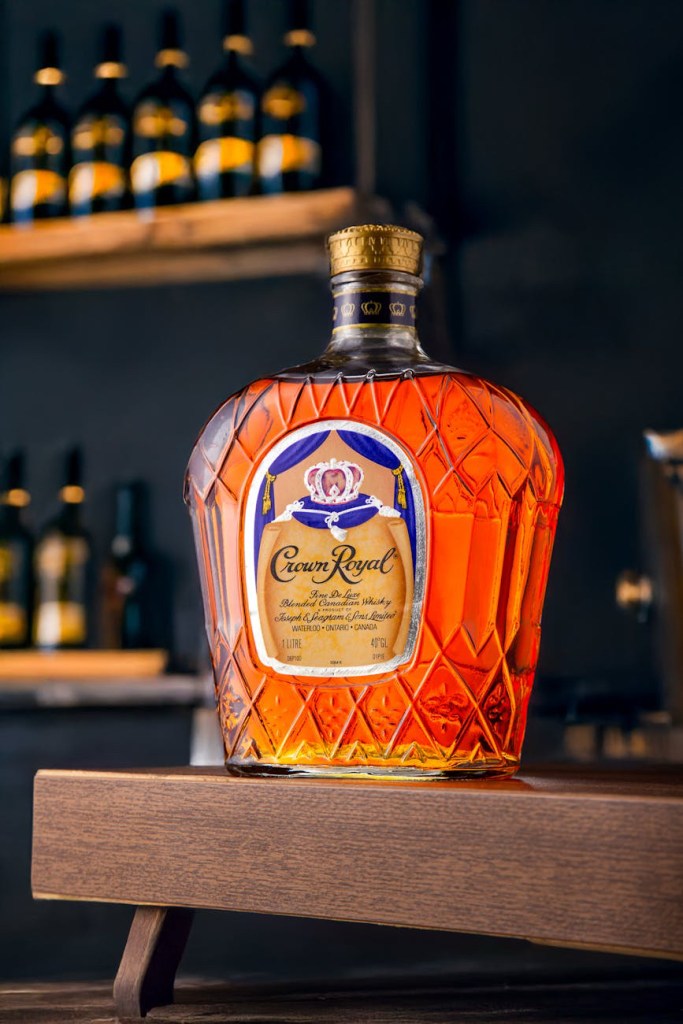
So instead of reaching for her, I quietly packed a mini bottle of Crown Royal in my hospital bag—in her place.
Not to drink. Not to numb.
But to name something.
Because Crown Royal was her liquor of choice.
That bottle wasn’t just whiskey.
It was legacy.
It was memory.
It was mourning.
I come from Crown Royalty—but not the kind of crown you wear with pride.
Purple velvet. Gold trim. Generational addiction disguised as something regal.
And Then—He Arrived
My son.
And with him, the ache deepened.
So did the longing for support—for someone to mother me while I became a mother myself.
And still—love showed up.
We were privileged to have a doula, a friend, who’d met me in one of the darkest seasons of my life. She stood beside me during labor—feeding me ice, playing my birthing playlist, offering encouragement. My oldest sister held my newborn while I slept—hours of sacred silence that let me breathe. My best friend—my chosen sister—brought food, care, and comfort. She stayed at the hospital as my baby fought for his life.
In those moments, I caught a glimpse of a different kind of royalty.
The Love of Christ—Earthside
Not passed down by blood.
Not tied to lineage or legality.
But chosen. Present. Redemptive.
The kind of love scripture speaks of.
The kind that breaks curses.
The kind that builds something new.
This is what I’m learning:
I may come from Crown Royalty.
But my son?
He comes from a new kind of crown.
One of grace.
Of chosen family.
Of love that stays.
Thank you for reading.
If this story resonates with you, know you’re not alone in your journey of longing, loss, and becoming.
 Finding Forty
Leave a comment